Tuesday, March 6, 2012

Éclairs, Tarts and Ice Cream… Oh My!

For someone like me embarking on a food quest in Paris, France is as thrilling as Dorothy, the Tin Man, the Scarecrow and the Cowardly Lion going to the Emerald City in the land of OZ.  As a lover fine food Paris is my magical, mystical Emerald City of culinary delights.  Hence the title “Éclairs, Tarts and Ice Cream…Oh My”.

It has become commonplace for my wife Linda and I to go off on a food quest in whatever city we are visiting. In the past we have scoured Barcelona for the best gelato and the best arroz con negro; Paris for the best baguettes, croissants, cassoulet and couscous, New Orleans for Sazerac, Rome for Spaghetti alla Carbonara and other food in other cities.  Half the fun is getting there. These food quests take us through new neighborhoods in cities we already know and sections of a city that we may not have otherwise visited. Naturally, when a reason for us to embark on one of these food odysseys presented itself for Paris France we relished the opportunity.
Before departing for Paris last year, my wife Linda scoured through our old collection of Paris Notes for little known sites and historic places to visit.  Amongst the wonderfully obscure factoids and trivia about Paris she uncovered a gold mine for her sweet tooth—Stohrer’s Patisserie Traiteur for éclairs, Les Petite Mitrons- Patisseries for tarts and Pascal, Le Glacier for ice cream.  She was hooked and I was a willing conscript to her expedition to find these patisseries and the praised glacier.  I must confess that I do not possess a sweet tooth that would compel me to make such quests.  Instead I reserve my calorie intake for food and wine.  Linda on the other hand would prefer to start her meals with desert, leaving whatever room there is left in her stomach for other food.  My reward for taking part in this expedition is reading the menus of the cafes and bistros along the way, not to mention savoring pastries and ice cream in the Emerald City of desserts. 
Day One: STOHRER - PÂTISSIER TRAITEUR

Magasin au 51 rue Montorgueil 75002 Paris
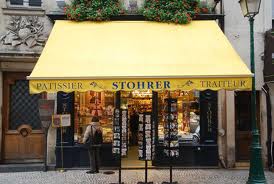

 From our studio apartment situated on Petit Ponte, on the left bank of the Seine we crossed  the Ile de la Cite, presided over by the towering edifice of Cathédrale Notre Dame de Paris  to the right bank. Passing the Thearte du Chatelet we walked up along Boulevard de Sebastopol teeming with shops and strollers to rue Etienne Marcel where we turned west to rue Montorgueil.  For my part finding rue Montorgueil was in itself sufficient reward for our long walk.  The street is packed with cafes, bistros, boulangeries, fromageries, boucheriers and charcuteries on both sides for about four city blocks long.  I was in food heaven and would have happily ended our journey with this discovery.  Linda was determined to taste the éclairs from Stohrer’s and so we continued our search for number 51 rue Montorgueil.   A little further up we came upon Stohrer’s landmark yellow canopy shading the shop’s blue façade. Above the canopy between two windows adorned with planter boxes, blooming with flowers a commemorative plaque proudly declared:
Patisserie Stohrer

Maison Fondèe en 1730

 Inside the shop a cornucopia of vividly colored cakes, tarts, éclairs bombes and chocolates, all perfectly aligned on glass shelves greeted us. Wonderful aromas of chocolate, fruit and dough wafted in the air titillating our taste buds.  Our mouths watered waiting to taste the long sought after éclair.  We were not disappointed when we finally ate our éclairs strolling along rue Montorgueil.  As an aside, I had my own éclair since Linda does not share pastries, especially delicious pastries.
The Stohrer’s éclair is a decadent mélange of delicious, rich dark chocolate topping a delicate French pasty filled with a creamy light chocolate mousse stuffing.  I cannot imagine a better éclair being made anywhere in France or anywhere else for that matter. 
After savoring the éclairs we lunched al fresco in one of bistros on rue Montorgueil Linda’s way, having had dessert first.  
Check back for day two’s food quest........


Tuesday, June 14, 2011

Pizza al Taglio -- Simply the Best!

     Reach back into your memory of taste sensations with me for a moment.   Summon the delicious flavors of a baked piece of very thin bread, moist and chewy with a crispy brown bottom, topped with a dabs of savory Fontana cheese, delicately accented with slices of fresh tomatoes, rich caramelized red onions, garlic and savory pieces of pancetta and we have just “tasted” the best pizza I ever had!
Declaring any food as the “best I ever had” is a phrase that I have strenuously stayed away from using until now.   Individual taste and personal preferences vary so much that such declarations are subjective at best.  To add to my unease with this phrase I have often been disappointed when tasting someone else’s “best” of anything.   Then there are times such as this when I savor food that is better than any other version of what I know to be very good or tasty, that I have no other choice but to simply say, this is the best I ever had.  Such is my esteem for the pizza I relished from a little Pizzeria in the Trastevere section of Rome, Italy.
     Tired and hungry, on our arrival in Rome we found ourselves hunting for a taste of the local fare when most Ristorantes and Trattorias are closed between lunch and dinner.   Tucked away on a little street off of the Viale Trastevere, near the Tiber River we stumbled upon Pizza al Taglio.  Much like a child with his nose pressed up against the glass storefront of his or her favorite toy store I beheld an array of rectangular trays of thin crusted pizzas.  I was overwhelmed with insatiable joy at the prospect of trying each and every one of their offerings available by the slice. The variety of toppings on each pizza tray included some of these mouthwatering choices: pancetta, tender slices of fresh mushrooms, tangy anchovies, flavorful caramelized red onions and what would become my favorite, the unlikely combination of potatoes and curry.   Each tray beckoned us to satisfy our hunger, which we did until there was no room for more.  Every mouthful was a taste experience long to be remembered, fresh morsels of different combinations of cheese, meat and vegetables atop a delicious pizza crust.
     The deliciously thin flavorsome pizza crust though is what sets Pizza al Taglio’s pizza apart from all other pizzas I have enjoyed.  The dough is made from Manitoba flour, a blend of wheat from North America whose origins are from the Canadian Provence of Manitoba.    According to Debra Rossi and Roberto Spagocci the owners of Pizza al Taglio, dough made from Manitoba flour can rise for as long as seventy-two hours.  The result is a crispy on the bottom, moist and chewy on top pizza crust that enhances the flavors of the toppings.  Combine this delicious pizza crust topped with fresh cheese, meat and vegetables, baked to perfection and the end result of this appetizing mélange is the best pizza I ever had.
Pizza al Taglio is located on the Via Cardinal Marmaggi, 12 in Rome Italy! 

Tuesday, February 22, 2011

Culinary Magic in Barcelona

      A little culinary magic takes place every day in a cozy Brasserie/Restaurant just ten minutes away from the hustle and bustle of La Ramblas in Barcelona. There is no other way to explain the picturesque, mouth-watering food coming out of the tiny kitchen in La Collita—it must be magic!
Fredy Naranjo - Magic at Work
Carpaccio of Shitake
     Cooking in less than fifty square feet (4.65m²) of space, Fredy Naranjo creates his culinary magic to the delight of his loyal customers with such Catalan favorites as: a casserole of small white beans with tender rings of calamares and mushrooms or a plate of juicy botifarra (sausage seasoned with cinnamon, nutmeg and cloves) or my favorite, crisp and tender grilled rabbit and more. Other delicious specialties of La Collita include an assortment of savory Risottos, velvety smooth rice dishes laced with mushrooms and ham or vegetables and prawns or my favorite, risotto with prawns and curry— a flavorful meal of rich rice, seasoned with curry and dotted with tender prawns.

A Tempting Dessert

"A Glass of Foie"

     We happened onto La Collita by chance. After a forty-eight hour journey from Phoenix, Arizona to Barcelona, Spain, a story on its own, my wife Linda and I threw down our luggage in our flat and went searching for food late that night. Travel weary and hungry we accidentally stumbled upon La Collita, a short walk from our flat that was to be our home for the next four months. Our good fortune continued when our server, a friendly young Serbian with an irrepressible smile spoke English well enough to explain some of their Catalan delicacies to us, such as: Carpaccio de Bacalao, paper thin slices of codfish drizzled with black olive oil, Queso de Cabras, a wonderfully nutty, semi-soft Spanish goat cheese and chorizo, a Spanish sausage flavored with paprika and garlic that is unlike any chorizo we have had in Arizona. Ever since that fortuitous night, we happily managed to find reasons to dine there at least once or twice a week. On our last night in Barcelona we bid the city farewell with another delicious meal at La Collita. I still long for another mouthful of Torrada de la Collita, a thick slice of toasted Catalan bread (similar to Ciabatta bread) covered with tender and not very salty anchovies, slices of pimentos and Queso de Cabras.
Bernard Dines Alfresco
     La Collita (The Harvest in Catalan) sits on the outer edge of the popular tourist areas of La Ramblas and the trendy La Ribera section, on Carrer Ramon Turro, just west of the tree lined Parc de la Ciutatdella. It is a small, unpretentious restaurant. The cozy dining room houses four tables, smartly set with white linen table cloths, wine glasses properly arranged and a small liquor service bar. Upstairs, six more tables are nestled under a wood beamed cathedral ceiling and surrounded by rustic brick walls. Dining alfresco is almost always an option in Barcelona as it is at La Collita. The service, watchfully attended to by Leon Salon, is always friendly, prompt and courteous and Fredy the magician creates culinary magic everyday from a kitchen that is too small for mere mortals.

The Magician!


Monday, November 1, 2010

A Wet Glass

“Stand up wherever you are, go to the nearest window and yell as loud as you can…”   Howard Beale (Peter Finch) in the motion picture Network

Never, in my wildest imagination did I ever anticipate writing about nightmarish restaurant experiences in this space devoted to the pleasures of food. Unfortunately, the time has come to stand up and shout, “I’m mad as hell, and I am not going to take it anymore.”

Over time, my expectations of the quality of food and service from the restaurants here in Southern Arizona have diminished to the point where I am pleased with merely “edible and adequate.” Most of the restaurants that I have tried in Southern Arizona have what I call a tourist mentality. They depend on the annual influx of temporary or one-time customers, such as part-time residents and tourists who change year after year. In other parts of the country, less dependent on “visitors” for their survival the restaurant’s emphasis is on building repeat customers all year long. When a tourist is displeased with the food or service in a restaurant, a different one will replace them next season. Conversely, a full-time resident is not likely to return after having several bad experiences. This is not a condemnation of our “snowbirds” or tourists; the area depends on them for its livelihood. It is, however, the business mentality of most of our restaurateurs, who rely upon a revolving door of one-time customers rather than building repeat business from full-time residents with quality food and service.

As a full-time resident in tourist areas such as Scottsdale and now south of Tucson, I have adjusted accordingly by ordering the most basic dishes on the menu, believing that any kitchen can produce a decent steak or hamburger. Regrettably, this has not always held true. I have also abandoned the notion of a drinkable glass of wine with my food since most of our area restaurants serve wine by the glass from bottles left opened for too many days or from ones that were never properly resealed. As a result, I found myself paying as much as twelve dollars for a glass of “swill” posing as wine. Having quietly endured this onslaught on my senses, the lack of anything resembling reasonable service has pushed me over the edge of silent acquiescence.

Recently, my wife Linda and I joined some friends for cocktails at a bar/restaurant in an upscale senior citizen community in Green Valley. We ordered our usual Dewar’s on rocks and our friends ordered two, ten-dollar glasses of wine. To my horror, one of the glasses of wine they were served was noticeably wet, inside and out. Adding to my chagrin, when I walked up to the bar asking for a dry glass, I received a “what’s wrong with this glass look” from the bartender. I was stunned. Obviously, the bartender did not see anything wrong with pouring wine into a wet glass and the server thought nothing of serving it that way. This act goes beyond the scope of my understanding. How can someone, who earns their living serving in a restaurant or bar, not know something as basic as—never serve wine in a wet glass!

The blame for this inexplicable act doe not lie with the bartender or the server alone. Management has a responsibility to ensure that their staff has, at the very least, a modicum of knowledge of what constitutes proper service. Patiently tolerating inexperienced wait staff is an unpleasant fact of dining-out in most restaurants in Arizona. Tolerating restaurant owners who do not know enough about the most basic aspects of service or care enough to educate their staff is unacceptable. Good food alone does not make for a pleasant dining experience, as good service does not excuse bad food. The combination of good food and proper service is what justifies the prices restaurants charge, not one without the other.

..........“I’m mad as hell, and I am not going to take it anymore!”

Friday, June 18, 2010

What Ever Happened to Pesto?

For those of us who were old enough to remember and have since forgotten and for those who were too young to notice, there once was a thick, dark green, luscious sauce gracing the plates of the chicest new restaurants in New York City. Scarcely a menue existed that did not have at least one or more offering of this flavor-rich addition to the fare. Tiny bits of minced garlic and pine nuts melded with chopped basil and pungent, grated parmesan cheese in lush olive oil to add distinction to the simplest servings of pasta. The lushest sauce of the hottest new restaurants then?—pesto!

The origin of the sauce we know today as pesto dates back to ancient Rome and was later refined in Genoa Italy. In New York City, during the late nineteen eighties pesto’s popularity grew to culinary acclaim. From the neighborhood coffee shop to the finest of restaurants, there was a pesto dish on everyone’s menu. Over time though, pesto has lost favor to today’s overwhelming assortment of herbs and spices in recipes. The mouth-watering pleasure of pesto is in its simplicity. It consists of five basic ingredients; fresh basil, pine nuts, garlic, parmesan cheese and olive oil. Together they come together to produce a nutty, rich taste sensation to enhance otherwise less flavorful food. Frequently served over pasta or as sauce for pizza it is also a welcomed addition to broiled fish, grilled chicken breast or add a dollop to bowl of hearty minestrone soup for more savory richness.

Originally, pesto was prepared in a marble mortar by crushing the dry ingredients with a wooden pestle by hand. Today, a simpler, easier and equally satisfactory method is with a food processor. Finely chop the fresh basil, pine nuts, and garlic in a food processor separately; combine the ingredients in a large mixing bowl, add the grated parmesan cheese, mix thoroughly and then slowly pour in the olive oil while constantly stirring the mixture to achieve a smooth, thick texture.

Here are the proportions for the basic ingredients. As with any recipe, adjust the amounts of each ingredient to your personal taste preference or add an interesting new ingredient such as sun dried tomatoes for a hint of sweetness or substitute the parmesan cheese with a more pungent Grand Padano cheese.

2 cups fresh basil, closely packed
½ cup extra virgin olive oil
¼ cup grated parmesan cheese
3 tablespoons pine nuts
3 cloves garlic

Pesto is quick and easy to prepare, getting richer and tastier as it sits in the refrigerator waiting to titillate your palate. One of my favorite ways to enjoy pesto is by adding a spoonful on top of a golden brown omelet or spread it over a piece of toasted ciabatta bread accompanied by a glass of Soave or Vinho Verdi. Enjoy!

Wednesday, May 5, 2010

A Proustian Pizza Memory from the Grill

Savoring pizza cooked on an outdoor grill is an uncommon taste experience with singular rewards. The hot charcoal briquettes or lava rocks add enticing, smoke-filled aromatics to the pie that conventional kitchen ovens cannot duplicate. The taste of the crunchy piecrust, topped with bubbling hot, melted cheese is wistfully reminiscent of the pizza served fresh out of the brick ovens from my bygone New York City neighborhood pizzerias. It is a Proustian Memory from my youth that I still relish with each morsel of pizza made on a grill.

One of the fundamental steps to successfully cooking pizza on an outdoor grill is bringing the temperature of the pizza stone, an essential tool, to the same temperature of the grill’s cooking chamber. The hot pizza stone sears the outside of the piecrust for a memorable, crispy and crunchy homemade pizza. The other equally important practice is elevating the stone from the grate, about two to three inches, with a metal vegetable basket or some other similar device that will not block the heat from the pizza stone. Elevating the stone in this manner places the uncooked pizza in the higher and hotter area of the cooking chamber to melt the cheese in the same amount of time necessary to cook the thin pizza dough.

The rest is easy; preheat the cooking chamber to 450° with the pizza stone in place, in order for the stone to reach the same temperature as the cooking chamber, slide the pizza with your favorite toppings onto the stone using a pizza peel. Close the cover to the grill and cook until finished. Randy Wade, the owner of Tumacookery in Tubac Arizona and my grilling guru, recommends a wooden pizza peel for this. When your piping hot, fresh made pizza is ready, slip a metal pizza peel underneath the crust, remove and enjoy! Following these simple steps will ensure a perfectly cooked pizza every time and—the creation your own Proustian Pizza Memory.

Randy Wade’s Signature Vegetarian Pizza Topping

Spread two tablespoons of extra virgin olive oil and two tablespoons of a balsamic vinegar reduction, or an equal amount of both, sufficient to cover the pie dough. Then add chopped arugula greens, a sprinkling of raw pecans and dried cranberries; the proportions of theses ingredient are to individual taste preferences; start with a quarter cup of each and adjust their amounts and proportions on your next pizza or pizzas. Finish the topping with thinly shaved slices of tangy Manchego cheese, sufficiently spaced for each slice to have its own shaving of cheese.

This no-fuss, easy to prepare combination of sweet and savory flavors elevates an ordinary pizza into a gourmet treat. Try a glass or two of Pinot Grigio by Cavit or a Soave by Inama; both are inexpensive Italian white wines that harmonize perfectly with the taste sensations of Randy’s vegetarian pizza.

Friday, April 2, 2010

A Trilogy of Enticing Meals and Snacks

The culinary secret for making delicious and inexpensive meals is in the sauce! Every chef has their own secret weapon that brings out the best in all their meals. Some drizzle expensive truffle oil on the food for added flavor right before serving, others may have a secret spice or ingredient that they use. Most successful chefs simply spoon-on fresh made, delectable sauces to turn ordinary food into memorable dishes. Rich and savory, succulent sauces also turn boring leftovers into sumptuous epicurean creations, enliven raw vegetable plates and change plain grilled fare into gourmet meals.

The purpose of a sauce is not to mask or disguise the taste of food. Its task is to enliven or enhance the flavor of food or offset it with a countering flavor, such as sweet and savory food combinations. Here are three different, unique and easy-to-make sauces that will impress your friends and family with your culinary expertise.

Garlic Lovers Sauce or Dip

Fresh garlic is a great, natural seasoning that makes almost any dish or food taste better. I have added sautéed garlic to fresh cooked spinach, crushed it into omelets and used whole cloves to add more flavor to chicken stock. I do not know of any food or recipe where garlic would not improve its taste—except perhaps crème brûlée.

The following garlic sauce is not just for garlic lovers; everyone appreciates a flavorful, tangy condiment with their food. There are two ways to make this sauce. The first is for the brave-hearted who love the taste of spicy tangy garlic. The second version is a softer more approachable garlic sauce. Either way this sauce is a perfect dip for raw vegetables, a spread for cold chicken sandwiches, leftover meats and other poultry or as a condiment for whatever your taste buds fancy.

Ingredients

8-10 cloves of crushed garlic
½ teaspoon of salt
1 egg
3 teaspoons of fresh lemon
1 cup of olive oil

Mix all the ingredients, except the olive oil, in a blender or food processor. Then with the blender or processor running, gradually pour in the olive oil. Note, as with making fresh mayonnaise the olive oil should be poured into the blender or processor very slowly to incorporate all the ingredients.

The amount of raw garlic determines just how tangy the sauce will be. One way to keep the garlic flavor and reduce its natural spicy taste is to first sauté the garlic cloves until they are light brown in color and then crush them for the sauce.

The finished sauce is a heavy, creamy emulsion of pungent garlic and lush olive oil. It is perfect as a dip or a spread for sandwiches. My wife Linda loves to spoon a dollop onto her omelet and also dip her steamed broccoli into it. No matter how the garlic lover’s sauce is used, it will energize any food it accompanies.

Savory Green Sauce for Fish or Seafood

This is one of my favorite sauces. I first tasted it in an enclave of Portuguese restaurants in Newark New Jersey; know as the “Ironbound” section of Newark. Green Sauce is a delicious mélange of onions, garlic and parsley simmered in white wine and fish stock or clam juice.

Savory Green Sauce is the perfect accompaniment for almost any broiled, grilled, fried or poached fish or seafood. It is a great flavor enhancer for broiled catfish, filet of sole or any fish that does not have much flavor on its own.

Ingredients

2 tablespoons olive oil
1 or 2 tablespoons of flour depending on desired consistency
¼ cup of finely chopped onions
3-6 cloves of minced garlic, to taste preference
1 cup of chopped fresh parsley no stems
½ cup of inexpensive white wine, preferably Sauvignon Blanc
½ cup of fish stock or broth or clam juice

In a saucepan, sauté the onions and garlic in the olive oil until they are soft but not brown. Slowly add the flour, constantly stirring the mixture to keep it from lumping. (This mixture of oil and flour is the basis for most sauces. Once the technique is mastered, a whole new world of wonderful sauces will grace your table.) Now slowly pour in the white wine followed by the fish stock, broth or clam juice while stirring constantly with a wired whisk or wood spoon. Be sure that all the liquids are room temperature before adding to the onion, and garlic mixture of olive oil and flour. Now add the chopped parsley and simmer on a very low flame or heat for about 5-10 minutes, stirring constantly until a thick and creamy consistency is reached.

This is a tasty, easy to make sauce. Feel free to adjust the amount of garlic and onions to your personal preference (the more the better).